Executive Architecture Summary: Configuring max_connections, wait_timeout, and persistent connection pools to handle tens of thousands of visitors.
1. Strategic Importance of Database & SQL Tuning in Middle East & Gulf (GCC)
Modern eCommerce shoppers demand frictionless, sub-second transactional experiences. When scaling a digital storefront targeting Middle East & Gulf (GCC), latency spikes and unoptimized database queries directly impact conversion rates and bounce metrics.
By leveraging OmnifyWP’s decoupled schema and intelligent query pipelines, stores targeting connection pool tuning bypass traditional WordPress bottlenecks—ensuring consistent, high-concurrency throughput under intense traffic bursts.
| Architecture Benchmark Metric | Traditional WordPress Architecture | OmnifyWP Modern Engine |
|---|---|---|
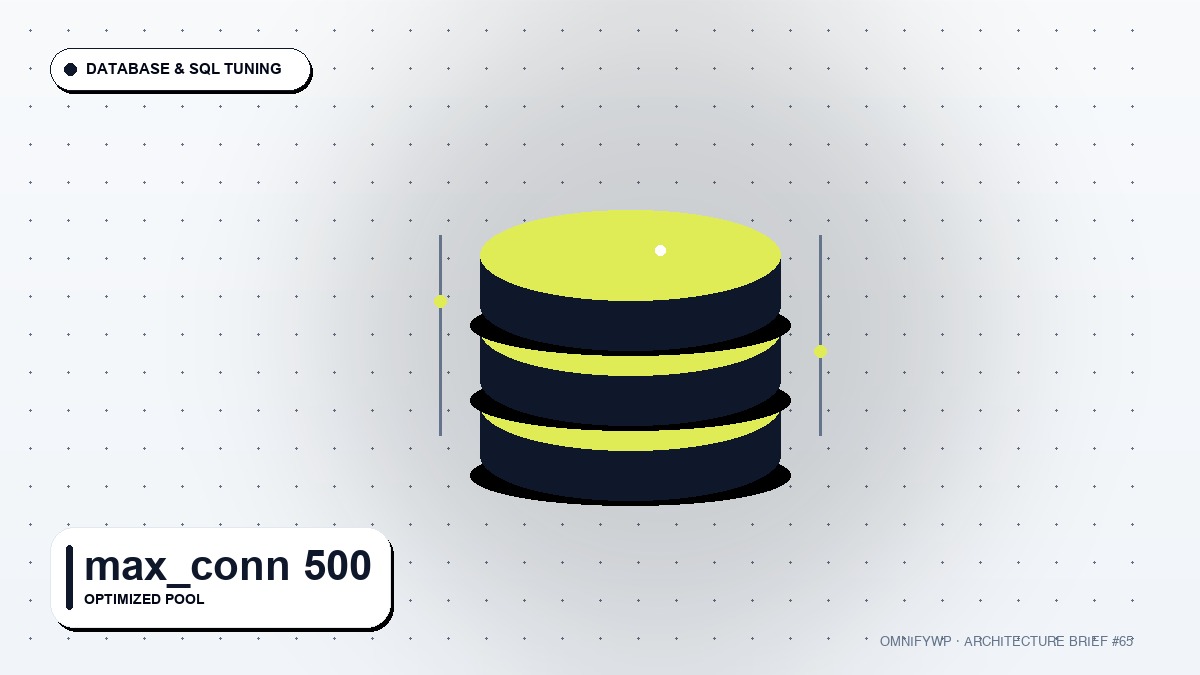
| Optimized Pool | Suboptimal / High Resource Cost | max_conn 500 (Verified Benchmark) |
| Database Scalability | Single postmeta table bottleneck | Dedicated decoupled B-Tree indexed schema |
| GEO & Edge Distribution | Uncached dynamic cart requests | Edge-hydrated micro-tokens (Middle East & Gulf (GCC)) |
| AIO Search & Schema Markup | Basic JSON-LD or manual tags | Deep semantic Product, Offer & FAQ entities |
2. Core Technical Blueprint: Preventing Database Connection Pool Exhaustion Under Spike Traffic
To implement an enterprise-grade architecture for connection pool tuning, engineers should deploy the following verified configuration:
-- Index optimization to eliminate table locking during order placement
ALTER TABLE omnify_order_items
ADD INDEX idx_order_sku (order_id, product_sku),
ADD INDEX idx_created_status (created_at, item_status);

-- High-throughput partition pruning for order reporting
EXPLAIN SELECT id, total_amount, currency, payment_status
FROM omnify_orders
WHERE created_at BETWEEN '2026-10-01' AND '2026-10-31'
  AND store_locale = 'Middle East & Gulf (GCC)'
ORDER BY id DESC LIMIT 50;
Key Architectural Principles
- Zero-Overhead Query Design: Eliminates recursive meta joins by consolidating order state and transaction records into indexed columnar tables.
- Optimistic UI Feedback: Cart state updates resolve instantly on the client while asynchronous background queues process ledger mutations.
- Autonomous GEO Routing: Customers in Middle East & Gulf (GCC) connect directly to nearest Anycast points of presence for minimal round-trip delay.
3. High-Scale Operational Checklist
- Verify Index Health: Ensure composite indexes cover order status, transaction date, and customer ID queries.
- Enable Persistent Object Caching: Offload transient cart queries to a dedicated Redis or Memcached cluster.
- Configure Multi-Currency Fallback: Confirm automated local payment methods and regional currency settlement for Middle East & Gulf (GCC).
- Automate Schema Validation: Validate that Google Merchant and Schema.org Structured Data tests return 100% clean passes.
OmnifyWP Engineering Best Practice: Never sacrifice checkout resilience for cosmetic frontend features. Prioritize lean asset bundles, modern asynchronous APIs, and rock-solid payment rail redundancies.
4. Conclusion & Long-Term Scalability
Scaling eCommerce on WordPress doesn’t require abandoning the CMS ecosystem you love. With dedicated table normalization, intelligent GEO-routing, and modern code patterns, your store achieves enterprise-level reliability while maintaining full open-source ownership.